

CulturePulse
Invested in 2026
Predicting Conflict
Before It Happens
Justin E. Lane, a computational social scientist, spent fifteen years studying why societies hold together and why they fracture, earned a DPhil at Oxford along the way, and wrote one of the first academic proposals to model social systems with AI. He co-founded CulturePulse with fellow social scientist F. LeRon Shults, a longtime collaborator, to put that research to work: where traditional polling takes weeks and LLM tools are too expensive and scientifically unproven to predict behaviour, CulturePulse builds psychologically realistic digital twins of entire populations, showing how people form beliefs, resist narratives, and shift toward or away from violence before it happens. Trusted by UN agencies, selected for NATO's DIANA accelerator, and proven from Northern Ireland to Bosnia and Herzegovina to the Middle East, it lets leaders simulate a decision a thousand times before they make it once for real.

Up to 80%
fewer deaths: with the UN Development Programme (UNDP) in Bosnia and Herzegovina, CulturePulse tested policy in simulation before rollout. Following implementation, gender-based deaths fell by an estimated 57 to 80% in 2025.
3 years in 5 minutes
CulturePulse reproduced a study of an entire national economy that had taken a supercomputer thousands of compute hours, matching or beating it in 45 minutes, and can run three years of that economy forward in just over five minutes, at a fraction of the cost.
200+ languages
Of applicants selected for NATO DIANA 2026, chosen among 150 companies from 3,680 submissions across 24 NATO nations — opening direct procurement pathways to allied forces at scale.
300+ papers
CulturePulse's founding team has published more than 300 peer-reviewed papers, the validated science its models are built on.
MISSION: Model how whole populations think and behave, so leaders can test a decision a thousand times in simulation before making it once for real.
Where a large-language-model approaches strain to fit a few hundred agents onto a bank of GPUs, CulturePulse fits hundreds of millions, and keeps every result auditable. Its non-LLM architecture models the reasoning of the prefrontal cortex, not just patterns in language, learning in real time across more than 200 languages without retraining. In one benchmark it reproduced a study of the entire Austrian economy, work that had taken a national supercomputer thousands of hours, at equal or better fidelity in 45 minutes.
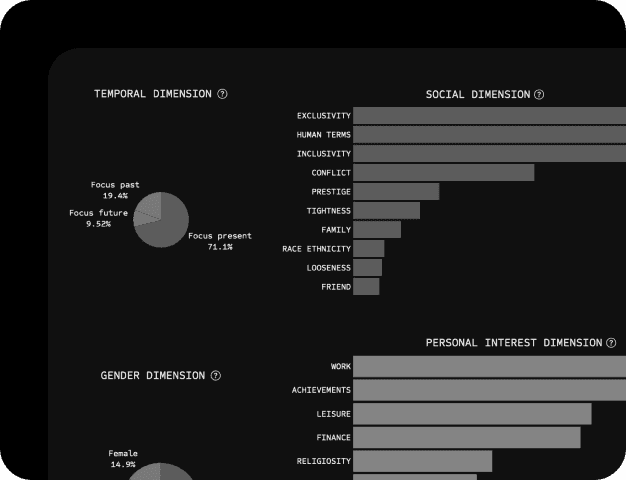
At its core is ARES, CulturePulse's platform for government and defence: it runs narrative detection, psychological segmentation, threat profiling, and scenario simulation, with ARES Insights as a lightweight version for rapid pilots below procurement thresholds. The same engine extends to enterprise, testing how audiences will react to messaging, campaigns, and brands before they go live and replacing costly surveys and focus groups. Both rest on population-scale Digital Twins, from a 5.5-million-agent model of Slovakia to one built from 86 million online profiles.
Deep tech of this kind usually takes a decade and $100M to field; five years in, CulturePulse already has its technology deployed in the real world, from Norway's COVID-19 information war to conflict forecasting across the Balkans and South Sudan. With a new UK subsidiary and national twins extending across Europe toward full NATO coverage, it is now moving from project work to recurring product revenue, as NATO and European defence budgets swing toward exactly the dual-use technology CulturePulse was built to provide.